VERIFIED TECHNICAL TERMINOLOGY
Technical Glossary
Formal definitions derived from the BowTie methodology, Layers of Protection Analysis (LOPA), and Critical Control Management (CCM), as applied in BowTie Easy and reference process safety literature.
- Auditability
- A barrier validity requirement: the existence of documented performance standards and verifiable inspection/test records that confirm the barrier is operational and fit-for-service.
- Official Source: CCPS, Energy Institute (2018) — Bow Ties in Risk Management: A Concept Book for Process Safety
- Barrier / Safeguard
- An operational or engineered measure that arrests a threat pathway or mitigates the consequence of a release. Must meet the core criteria of independence, effectiveness, and auditability.
- Official Source: CCPS, Energy Institute (2018) — Bow Ties in Risk Management: A Concept Book for Process Safety
- CCPS (Center for Chemical Process Safety)
- A technical community of the American Institute of Chemical Engineers (AIChE) that, together with the Energy Institute, authored the benchmark concept book for BowTie analysis in process safety.
- Official Source: CCPS, Energy Institute (2018) — Bow Ties in Risk Management: A Concept Book for Process Safety
- Consequence
- An undesirable outcome resulting from the Top Event, expressed in terms of personnel injury or fatality, asset loss, environmental degradation, or business interruption.
- Official Source: CCPS, Energy Institute (2018) — Bow Ties in Risk Management: A Concept Book for Process Safety
- Critical Control
- A safeguard crucial to preventing a major unwanted event or mitigating its consequences. The absence or failure of a critical control significantly increases risk despite other existing safeguards.
- Official Source: CCPS, Energy Institute (2018) — Bow Ties in Risk Management: A Concept Book for Process Safety
- Critical Control Management (CCM)
- A management framework formalized by the International Council on Mining and Metals (ICMM) to define, implement, verify, and report the operational health of controls critical to preventing fatal accidents.
- Official Source: ICMM (2026) — Critical Control Management: Good Practice Guide
- Effectiveness
- A barrier validity requirement: the demonstrated physical and functional capability of the control to terminate 100% of the threat sequence or sufficiently mitigate consequence impact.
- Official Source: CCPS, Energy Institute (2018) — Bow Ties in Risk Management: A Concept Book for Process Safety
- Escalation Factor (Degradation Factor)
- A condition, failure mechanism, or operational deviation that degrades or defeats the effectiveness of a primary barrier without causing the Top Event directly.
- Official Source: CCPS, Energy Institute (2018) — Bow Ties in Risk Management: A Concept Book for Process Safety
- Hazard
- An operation, activity, or material with the intrinsic potential to cause harm to people, assets, the environment, or reputation. It is not the accident itself, but the energy source or hazard state that must be held under positive control.
- Official Source: CCPS, Energy Institute (2018) — Bow Ties in Risk Management: A Concept Book for Process Safety
- Independence
- A barrier validity requirement: the safeguard must act completely autonomously, sharing no common-cause failure modes, initiators, or utilities with other barriers on the same sequence.
- Official Source: CCPS, Energy Institute (2018) — Bow Ties in Risk Management: A Concept Book for Process Safety
- LOPA (Layers of Protection Analysis)
- A semi-quantitative risk assessment method analyzing initiating event frequency, independent protection layer (IPL) probability of failure on demand (PFD), and consequence severity to evaluate whether risk is reduced to tolerable or ALARP levels.
- Official Source: CCPS, Energy Institute (2018) — Bow Ties in Risk Management: A Concept Book for Process Safety
- PAER (People, Assets, Environment, Reputation)
- A standard four-pillar consequence classification framework preloaded in BowTie Easy, fully modifiable to match internal organizational risk schemas.
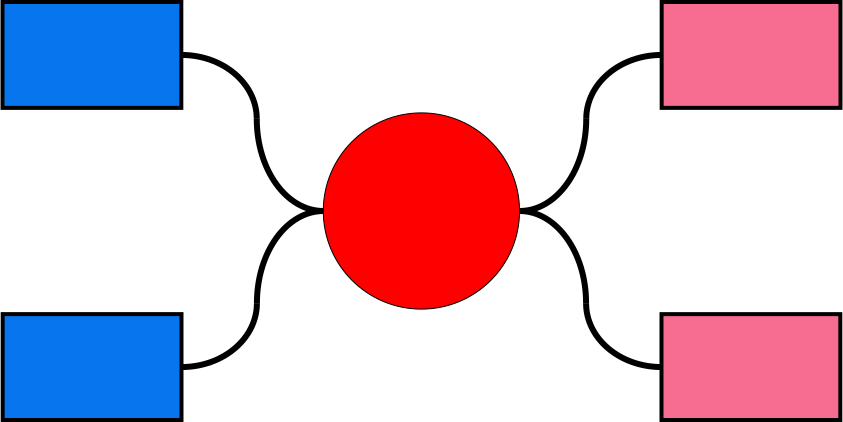
- Proactive (Left-Hand) Side
- The left-hand section of a BowTie model: initiating threats and prevention barriers acting prior to the loss of control or containment.
- Official Source: CCPS, Energy Institute (2018) — Bow Ties in Risk Management: A Concept Book for Process Safety
- Reactive (Right-Hand) Side
- The right-hand section of a BowTie model: mitigation barriers and consequences active post-release to minimize consequence severity.
- Official Source: CCPS, Energy Institute (2018) — Bow Ties in Risk Management: A Concept Book for Process Safety
- Residual Risk
- The remaining level of risk after accounting for the risk-reduction effect of implemented barriers. Projected risk models the expected residual risk after completing corrective action plans.
- Risk Matrix
- A structured grid combining likelihood and severity categories to rank scenario risks. In BowTie Easy, dimensions, thresholds, and scoring are fully configurable to corporate standards.
- Threat
- A credible operational or environmental initiating cause that, on its own and in the absence of barriers, is sufficient to lead directly to the Top Event.
- Official Source: CCPS, Energy Institute (2018) — Bow Ties in Risk Management: A Concept Book for Process Safety
- Top Event
- The central focal point of a BowTie diagram: the release of hazard energy or the loss of physical control/containment over a specific hazard. It separates proactive threat pathways on the left from reactive consequence sequences on the right.
- Official Source: CCPS, Energy Institute (2018) — Bow Ties in Risk Management: A Concept Book for Process Safety